
Buisness
Best Crypto Portfolio Tracker in 2025
The way investors manage their crypto portfolios has shifted dramatically over the last decade. What once relied on spreadsheets and manual bookkeeping has evolved into real-time dashboards powered by automation. This section explains how that transition unfolded and why the debate over manual versus automated methods remains central in 2025.
From spreadsheets and manual logs to automation-first solutions
Early adopters of digital assets relied almost entirely on manual methods. Every trade, transfer, or staking event was recorded in Excel or Google Sheets. While this offered full control, it required constant effort and carried a high risk of mistakes. As portfolios became larger and spread across multiple chains, keeping them balanced by hand became unmanageable.
By 2025, automation dominates the field. Portfolio platforms now connect directly to exchanges, wallets, and DeFi protocols, pulling live data without user input. This shift not only saves time but also reduces the likelihood of errors that once plagued manual logs.
Case example: A user with BTC on Coinbase, ETH in MetaMask, and stablecoins staked in Curve used to track three separate records. Today, automated dashboards merge all these positions instantly, calculating fees, staking yields, and ROI without manual updates.
Why the debate between manual control and automated tools is central in 2025
Even as automation becomes the default, not everyone is comfortable with handing full control to dashboards. Some investors prefer manual oversight to verify accuracy, particularly when new protocols or assets are unsupported. Security is another concern, since automation often requires API keys, which some users hesitate to share.
On the other hand, those embracing automation argue that precision and scale are impossible otherwise. Portfolios containing hundreds of trades, multiple yield strategies, and cross-chain positions are simply too complex for spreadsheets. For them, the key benefit lies in reducing workload while maintaining accuracy.
“Automation saves time, but manual oversight keeps you in control. The real challenge is finding the right mix.”
Automation vs. Manual
The tension between automation and manual management is not just a technical issue – it reflects how investors balance trust, control, and cost. Each factor plays a different role in shaping how modern portfolio platforms are used, and why preferences still vary widely.
Precision in ROI and PnL calculations
Accuracy is the first metric by which any portfolio solution is judged. Investors want reliable numbers for realized and unrealized profit, staking income, and trading fees. Manual tracking can, in theory, achieve this precision, but in practice the margin for human error is high. Automated systems, by pulling data directly from APIs and block explorers, reduce mistakes and update results in real time.
Still, automation is not perfect. Some platforms misinterpret transactions or lag behind new protocol integrations, which leads to distorted ROI figures. This is where manual oversight remains useful: investors can step in to adjust entries that algorithms don’t handle well.
Flexibility and user control
Flexibility defines how much influence the user retains over the data. Manual logs provide absolute control – every entry is chosen, corrected, or deleted by hand. This appeals to meticulous investors who want to verify every transaction.
Automated dashboards trade some of that control for efficiency. While they offer customization, such as editing transaction categories or adjusting cost basis, they rarely allow the complete freedom of spreadsheets. The trade-off becomes clear: do you value speed and convenience, or do you prefer maximum oversight?
Security implications of automation
Security is one of the most discussed topics in the automation debate. Connecting exchanges and wallets through APIs exposes data flows that must be protected. While reputable platforms request read-only API keys and use encryption, investors remain cautious. The risk of providing higher-level permissions, as required by some trading bots, is a sticking point.
Manual methods avoid this issue entirely, since no third-party service ever touches account credentials. However, the downside is the constant workload and higher chance of errors in reporting. Investors must weigh whether the reduced security exposure of manual methods justifies the inefficiency.
Cost and accessibility of advanced features
Finally, there’s the question of cost. Manual logs are essentially free – Excel and Google Sheets only require time. Automation, by contrast, often comes with subscription fees, especially for features like tax-ready exports or cross-chain analytics.
For small portfolios, the cost may feel unnecessary, but for active traders and institutions, the subscription quickly pays for itself in saved time and reduced mistakes. Accessibility also varies: some premium platforms lock essential features behind higher tiers, while others offer useful basics at no cost.
“Manual methods cost time, automation costs money. The decision depends on which resource you value more.”
Table: Manual vs. Automation trade-offs
| Factor | Manual approach | Automated platforms |
| ROI/PnL accuracy | Prone to human error, but customizable | High precision, but dependent on coverage |
| Flexibility | Full user control over entries | Limited to platform rules and settings |
| Security | No third-party exposure | Requires API keys and platform trust |
| Cost | Free, but time-intensive | Paid tiers, but time-efficient |
1. CoinDataFlow
https://coindataflow.com/en/portfolio-tracker
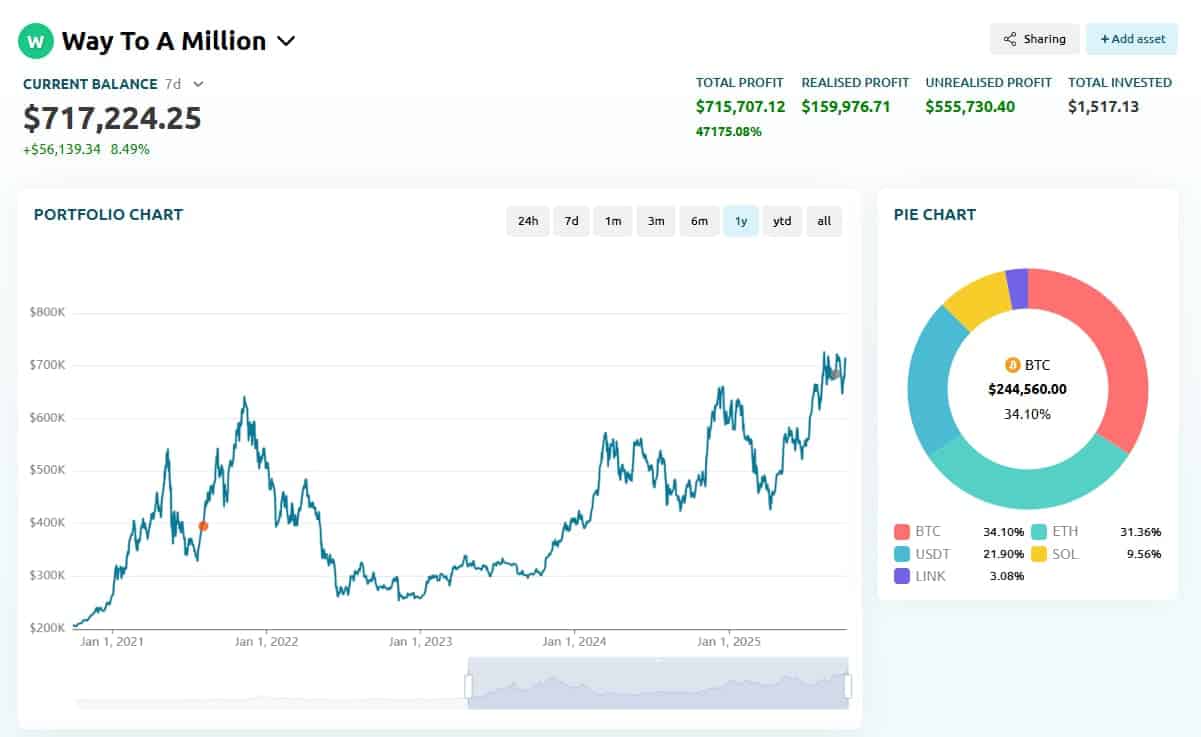
CoinDataFlow has built its reputation by merging automation with transparency. It doesn’t force users into a purely automated system but instead creates a framework where automated syncing coexists with manual oversight. This hybrid approach has attracted both semi-professionals and advanced investors who want efficiency without losing the ability to correct or verify entries.
Balanced automation with clear manual oversight
The platform connects directly to exchanges, wallets, and DeFi protocols through secure APIs. Balances, staking rewards, and fees are updated live. At the same time, users can manually edit transactions, adjust cost basis, or override automated entries if discrepancies appear. This dual structure prevents blind reliance on automation while removing the repetitive burden of spreadsheets.
Reliable ROI/PnL reporting and live market sync
CoinDataFlow emphasizes reporting accuracy. It recalculates ROI and PnL in real time, accounting for transfers between wallets, staking yields, and transaction fees. Historical views allow investors to examine performance across weeks, months, or years. This level of transparency is particularly useful for traders preparing tax documentation or investors presenting performance reports.
Table: ROI/PnL accuracy comparison
| Feature | CoinDataFlow | Manual logs | Typical competitor |
| Realized vs. unrealized PnL | ✅ | Custom, error-prone | Partial |
| Transfer reconciliation | ✅ | Manual edits | Often inconsistent |
| Staking/yield integration | ✅ | Manual updates | ❌ |
| Historical performance | ✅ | Limited by user | Limited |
Minimal weaknesses compared to peers
While packed with features, CoinDataFlow remains approachable. The main criticism from some beginners is that the dashboard feels dense at first glance. However, compared to competitors that either oversimplify or overwhelm with trading bot complexity, this trade-off is minor. Mobile usability is improving, though the desktop platform remains the primary strength.
Strengths:
- Hybrid model: automation + manual control.
- High accuracy in ROI/PnL calculations.
- Wide integration range across CEX, wallets, DeFi.
- Export-ready for taxes and compliance.
Weaknesses (minor):
- Interface density may challenge newcomers.
- Mobile app lags behind desktop in depth.
“CoinDataFlow bridges the gap between spreadsheets and bots – precise automation where it matters, with manual oversight where it counts.”
2. Coinexplorers
https://coinexplorers.com/portfolio
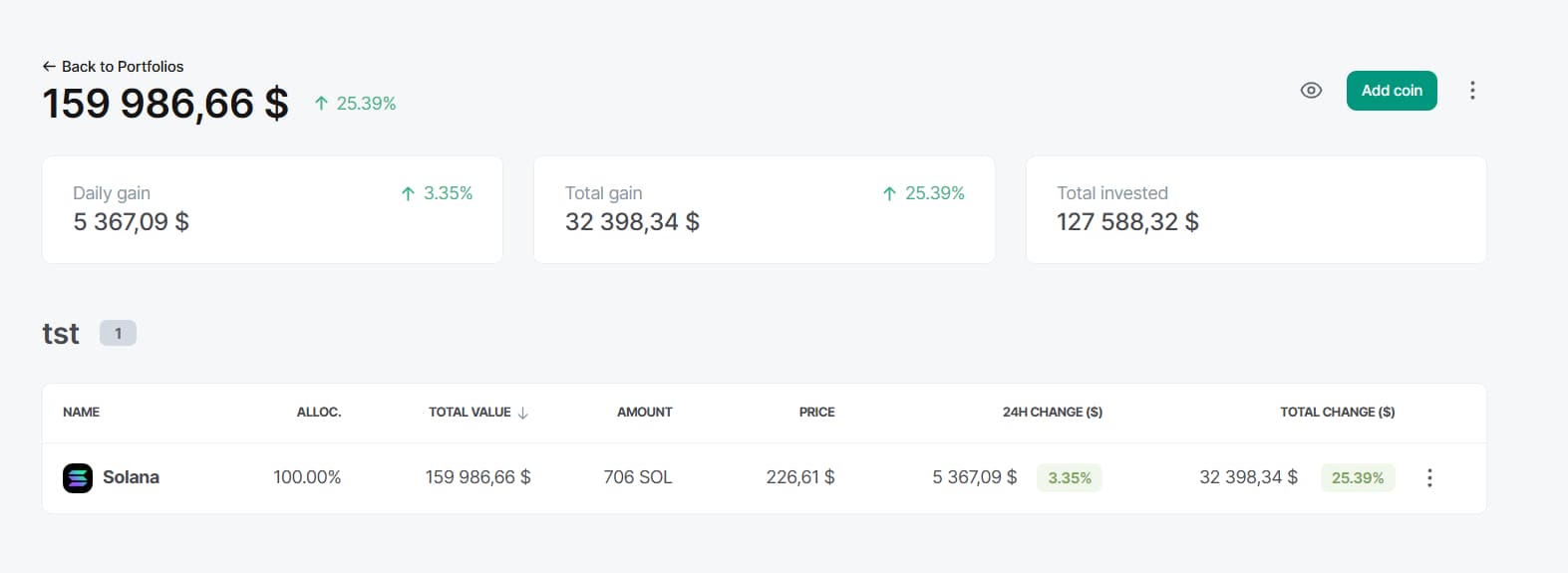
Coinexplorers is a relative newcomer to the portfolio management space. Its main appeal lies in simplicity: the platform lowers barriers for beginners who want to test automation without diving into highly technical setups.
Newcomer-friendly approach
The onboarding process is straightforward. Users can connect a few exchanges or wallets and immediately see balances reflected in the dashboard. Basic ROI/PnL figures are calculated automatically, with charts kept minimal to avoid overwhelming first-time users.
Example: A casual investor holding BTC on Coinbase and a small amount of ETH in MetaMask can sync both in minutes. The interface provides a clean allocation chart and a simple gain/loss overview.
Weak points in deeper automation features
Where Coinexplorers shows its limits is in advanced automation. It lacks robust integrations with DeFi protocols, NFT platforms, or tax-reporting systems. Historical ROI views are shallow, and customization for cost basis or manual adjustments is minimal. This means that once portfolios grow complex, the tool feels underpowered compared to more mature competitors.
Table: Coinexplorers snapshot
| Category | Strength | Weakness |
| Onboarding | Quick and easy setup | Few customization options |
| ROI/PnL reporting | Basic, suitable for small accounts | Lacks historical depth |
| Integrations | Covers main CEX + wallets | Weak in DeFi, NFTs, and tax automation |
| Audience fit | Beginners exploring automation | Less suitable for serious investors |
Strengths:
- Easy for newcomers to get started.
- Clean, uncluttered interface.
- Free or low-cost entry point.
Weaknesses:
- Shallow automation depth.
- Limited reporting accuracy at scale.
- Not designed for professional or institutional use.
“Coinexplorers works as a gentle introduction to automated tracking, but it doesn’t hold up for complex portfolios.”
3. Nansen Portfolio
https://www.nansen.ai/crypto-portfolio-tracker
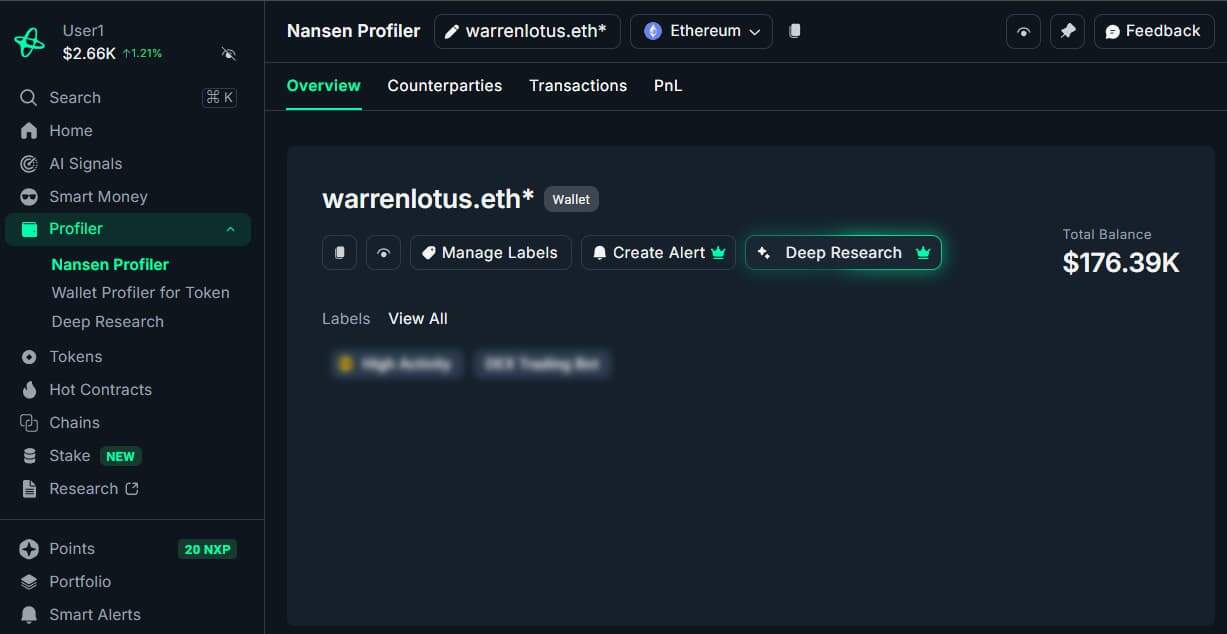
Nansen Portfolio extends the company’s reputation in blockchain analytics into portfolio tracking. It is aimed at users who want not just balances, but deep on-chain intelligence integrated into their dashboards.
On-chain analytics and automated insights
What sets Nansen Portfolio apart is its ability to pull behavioral data from blockchain activity. It doesn’t just show holdings – it highlights wallet movements, identifies correlations, and suggests actions based on large-scale on-chain flows. For advanced traders and funds, this creates a layer of intelligence that goes beyond traditional ROI and PnL.
Example: An investor tracking multiple wallets sees Nansen automatically flag unusual inflows into an altcoin liquidity pool. The dashboard not only records the position but also provides context from broader on-chain signals.
High complexity and steep pricing
The sophistication of Nansen Portfolio comes with trade-offs. The interface can overwhelm those unfamiliar with on-chain metrics, while the subscription fees place it out of reach for casual investors. It is clearly targeted at power users, analysts, and institutions rather than retail traders.
Table: Nansen Portfolio overview
| Category | Strength | Weakness |
| Analytics | Deep on-chain intelligence, unique insights | Overwhelming for non-technical users |
| Automation | Automated alerts and correlations | Limited manual adjustment options |
| Pricing | Premium, institution-level | Expensive for individuals |
| Audience fit | Analysts, funds, advanced traders | Not suited to beginners |
Strengths:
- Unmatched on-chain analytics.
- Automated alerts that anticipate trends.
- Valuable for funds and high-level traders.
Weaknesses:
- Complex interface not beginner-friendly.
- Very high subscription costs.
- Overkill for simple portfolios.
“Nansen Portfolio turns tracking into intelligence, but its depth comes with cost and complexity.”
4. Zapper
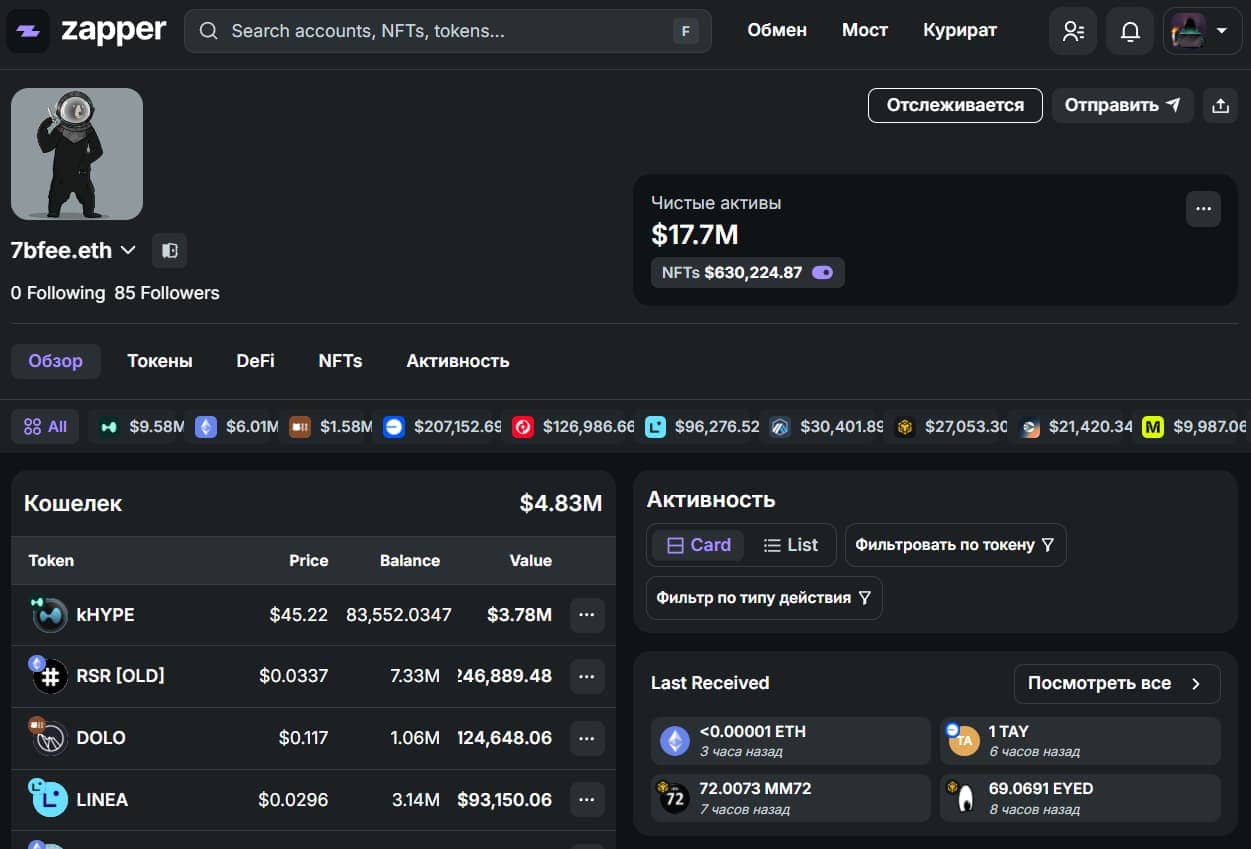
Zapper has built its identity around decentralized finance. It’s one of the first platforms to make complex DeFi positions visible in a simple, user-friendly interface. For users deep in Web3 ecosystems, it remains a popular choice.
Strong automation for DeFi and NFT tracking
Zapper automatically scans wallet addresses and compiles DeFi positions across multiple blockchains. Liquidity pools, yield farming rewards, and staking balances appear without manual input. In addition, NFT collections are displayed with floor price estimates and gallery views, making it useful for those combining DeFi with NFT investing.
Example: A user with positions in Uniswap pools, Curve staking, and NFTs on Ethereum connects their MetaMask wallet. Zapper instantly generates an overview of all holdings, with rewards updated in real time.
Lack of centralized exchange integration
The major gap in Zapper is centralized coverage. Balances on exchanges like Binance, Kraken, or Coinbase aren’t natively integrated, forcing hybrid investors to combine Zapper with another tracker. This makes it less appealing for those balancing CEX and DeFi simultaneously.
Table: Zapper assessment
| Category | Strength | Weakness |
| DeFi tracking | Automatic, across multiple protocols | Focused mainly on Ethereum ecosystems |
| NFT integration | Portfolio + gallery with price estimates | Accuracy can fluctuate |
| CEX coverage | — | Lacks direct integrations |
| Audience | Web3-focused investors | Not suited for hybrid portfolios |
Strengths:
- Excellent at DeFi and NFT visualization.
- Automation removes manual tracking burden.
- Interface tailored for Web3-native users.
Weaknesses:
- Missing CEX integrations.
- Limited as a full-spectrum tracker.
- Less useful for traditional or mixed investors.
“Zapper shines for DeFi and NFTs but leaves centralized portfolios out of the picture.”
5. Koinly
https://koinly.io/crypto-portfolio-tracker
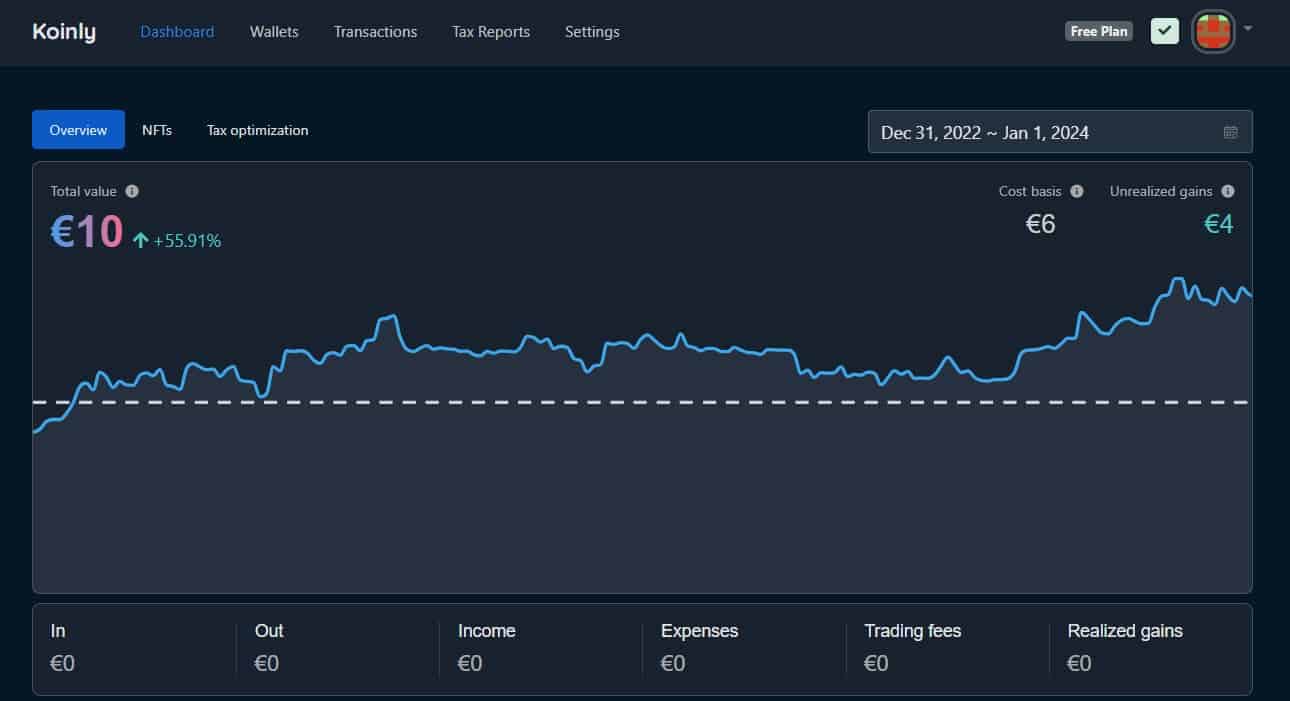
Koinly has carved out a niche as one of the leading tax-focused platforms in crypto portfolio management. It emphasizes compliance and reporting above daily usability, making it a go-to choice for investors preparing for tax season.
Tax automation as its primary strength
The core feature of Koinly is its ability to generate tax-ready documents across multiple jurisdictions. It connects with exchanges, wallets, and some DeFi protocols to consolidate transaction histories into structured reports. For users in countries with strict reporting requirements, this automation reduces the manual burden significantly.
Example: A UK-based trader imports thousands of transactions from Binance, Uniswap, and Coinbase. Koinly processes the data and outputs HMRC-compliant tax reports ready for submission.
Limited usability for real-time portfolio tracking
Despite its strength in compliance, Koinly feels less practical as a daily tracker. The interface is designed around tax categories and audit trails, not quick portfolio insights. ROI and PnL are calculated, but often displayed in formats better suited for accountants than investors. For everyday portfolio monitoring, the experience feels heavy and less intuitive.
Table: Koinly overview
| Category | Strength | Weakness |
| Tax reporting | Automated, multi-jurisdiction support | Subscription required for large volumes |
| Portfolio tracking | Covers basics | Feels secondary to compliance focus |
| Integrations | Strong with CEX, partial with DeFi | NFT tracking limited |
| Audience | Tax-conscious investors, accountants | Not ideal for casual users |
Strengths:
- Strong tax automation across countries.
- Reliable CEX integrations.
- Cuts down compliance workload dramatically.
Weaknesses:
- Daily tracking feels secondary.
- Less suited for DeFi and NFT-heavy portfolios.
- Premium pricing for high-volume traders.
“Koinly simplifies reporting but doesn’t feel like the dashboard you’d open daily for portfolio insights.”
6. CoinTracking
https://cointracking.info/crypto-portfolio-tracker
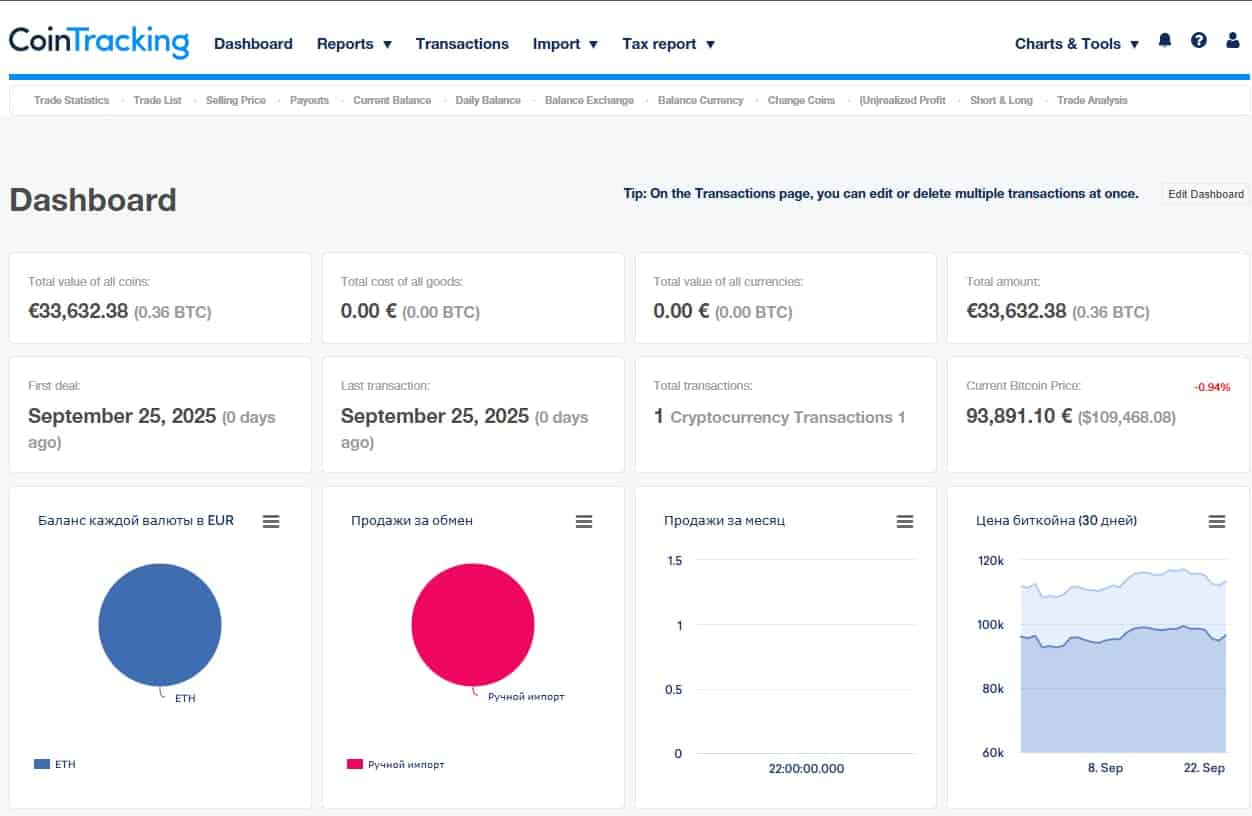
CoinTracking is one of the oldest and most established names in crypto portfolio management. Unlike lightweight dashboards, it leans heavily on detailed records and advanced reporting, attracting users who value depth and customization.
Robust manual data input and historical records
One of CoinTracking’s defining features is its support for manual entry alongside automated imports. Investors can upload CSVs, correct individual trades, and maintain precise historical data over years of activity. This makes it popular with long-term holders or active traders who want a permanent archive of every transaction.
Example: An investor with trades dating back to 2016 uploads historical CSV files from multiple exchanges. CoinTracking merges them into a single timeline, showing realized and unrealized PnL across nearly a decade.
Overwhelming for beginners; premium plans costly
The platform’s strength in detail can also be intimidating. Its interface feels more like accounting software than a portfolio dashboard, with dozens of menus and report types. New users often struggle to navigate the options. Additionally, many of the most useful features – such as tax reporting, API imports beyond a certain limit, and advanced analytics – sit behind premium pricing tiers, which can be expensive for casual traders.
Table: CoinTracking snapshot
| Category | Strength | Weakness |
| Manual data input | Strong CSV + custom entry support | Time-consuming for newcomers |
| Historical reporting | Decade-long transaction history possible | Interface complexity |
| Tax and compliance | Wide jurisdiction coverage | Premium subscription required |
| Audience fit | Advanced traders, long-term investors | Less friendly for casual or new users |
Strengths:
- Excellent for historical record-keeping.
- Robust mix of manual and automated imports.
- Deep compliance and tax functionality.
Weaknesses:
- Steep learning curve for new users.
- Interface resembles accounting software more than a tracker.
- Premium plans are costly for small portfolios.
“CoinTracking delivers unmatched detail, but the complexity and cost make it best suited for serious long-term users.”
7. Bitwave
Bitwave is built for enterprises rather than individual traders. Its focus is on compliance, accounting, and automation at a scale that matches corporate finance needs.
Institutional-grade automation for compliance and accounting
The core of Bitwave lies in its ability to integrate crypto transactions directly into corporate accounting systems. It automates categorization, creates audit trails, and aligns records with accounting standards such as GAAP or IFRS. For companies holding digital assets on their balance sheets, this removes hours of manual reconciliation.
Example: A fintech startup using QuickBooks integrates Bitwave. All crypto transactions from its wallets and exchanges automatically flow into the accounting system, complete with tax categorization and audit logs.
Complexity and costs make it unsuitable for individual investors
While perfect for enterprises, Bitwave’s tools overwhelm individual users. Its interface assumes knowledge of accounting practices and compliance frameworks. Pricing is also structured for corporate contracts, far beyond what retail investors are willing or able to pay. As a result, it has little relevance for casual traders or even semi-professionals.
Table: Bitwave at a glance
| Category | Strength | Weakness |
| Compliance | Full integration with accounting systems | Overly complex for retail use |
| Automation | Audit-ready categorization and reporting | Cost structure aimed at enterprises |
| Usability | Designed for finance teams and auditors | Not intuitive for individuals |
| Pricing | Enterprise contracts | Too expensive for small portfolios |
Strengths:
- Enterprise-grade compliance automation.
- Seamless integration with accounting platforms.
- Strong fit for companies managing digital assets.
Weaknesses:
- Overly complex for individual traders.
- Pricing excludes retail adoption.
- Limited usability outside of corporate environments.
“Bitwave functions more like enterprise accounting software than a retail portfolio tracker.”
What the Comparison Shows
After reviewing the main platforms, clear themes emerge. Each service has carved its space, yet their strengths and weaknesses reveal why investors often seek balance rather than extremes.
Common ground between solutions
Most portfolio trackers in 2025 provide at least basic API integrations with exchanges and wallets. Tax alignment is also widely supported, reflecting how regulation has become central to digital asset management. Another shared trait is the attempt to simplify multi-chain complexity: almost all platforms now display holdings across Ethereum, Solana, BNB Chain, and others, even if coverage varies.
Table: Features most platforms share in 2025
| Shared Feature | Why it matters |
| Exchange & wallet integration | Eliminates manual data entry |
| Tax report exports | Meets regulatory demands |
| Multi-chain balance view | Helps investors track diverse holdings |
| ROI/PnL history | Tracks performance beyond spot prices |
Persistent weak spots in the market
Even with progress, gaps remain. Usability often suffers when tools prioritize tax or compliance over daily tracking. Many platforms also fall short in handling DeFi and NFTs with the same accuracy they apply to centralized exchanges. Pricing creates another barrier: while free plans exist, advanced features usually sit behind expensive subscriptions.
“For many investors, the hardest part isn’t finding a tool with features – it’s finding one that feels balanced and affordable.”
Why some platforms feel more balanced than others
The difference comes down to execution. Platforms that combine accurate ROI/PnL, reasonable pricing, and an interface usable by both newcomers and professionals naturally stand out. Some services emphasize depth but overwhelm users, while others simplify too much and lose reliability. A select few, however, manage to bridge both sides, making them better positioned for long-term adoption.
Example: A casual trader may prefer a clean, intuitive interface with automated imports, while a professional analyst demands detailed export options and compliance reports. Platforms that serve both without forcing trade-offs are rare, and those that do are naturally perceived as stronger.
FAQ
This section addresses the practical questions investors often search for when considering portfolio platforms in 2025.
What tracker is best for new investors in 2025?
Beginners usually look for simplicity above everything else. A good option is a platform with automatic imports, clear ROI/PnL, and minimal setup. Free or low-cost plans often provide enough functionality for someone just starting out.
Do I need to pay for advanced portfolio management?
Not always. Free tiers often handle basic tracking, but advanced automation, multiple wallet integrations, and detailed reporting usually require paid subscriptions. The decision depends on how complex your portfolio is and whether tax and compliance reporting is essential.
Can these apps track DeFi and NFTs?
Yes, many dashboards now include DeFi protocols and NFT collections. However, accuracy can vary. While DeFi-native tools excel in this area, some general-purpose platforms still struggle to capture every token or yield reward.
How safe is it to link my exchange account?
Most platforms use read-only API keys, meaning they cannot move funds. Security depends on how the service stores and encrypts these keys. Non-custodial trackers, which never hold your assets directly, tend to provide greater peace of mind.
Which innovations define the 2025 generation of portfolio trackers?
Several new features are becoming standard:
- AI-driven alerts that flag risk exposures or suggest rebalancing.
- Cross-chain unification, showing one net worth across Ethereum, Solana, BNB Chain, and more.
- Automated tax exports in multiple jurisdiction formats.
These innovations aim to reduce complexity and make daily management less stressful.
Are institutional tools relevant for individuals?
Usually not. Platforms built for enterprises focus on compliance, accounting integration, and multi-billion asset custody. While powerful, they tend to be expensive and unnecessarily complex for retail users. Still, some semi-professional investors borrow ideas from these solutions, especially in tax preparation.
The 2025 landscape of portfolio management shows how far the market has evolved from the days of manual spreadsheets. Investors no longer ask if they should use a tracker, but which one can actually keep pace with their needs. The comparison of premium and mainstream platforms highlights both common strengths and recurring shortcomings.
One key observation is that most tools now meet basic expectations: they connect to exchanges, track multi-chain balances, and offer tax exports. Yet, the real distinction lies in how seamlessly they deliver accuracy, security, and usability together. Some dashboards tilt too far toward compliance, becoming unwieldy for everyday use. Others emphasize simplicity but sacrifice depth.
The middle ground – tools that maintain precise ROI and PnL, integrate across chains and services, and remain approachable – defines the solutions most likely to retain serious investors. Those platforms are not just functional; they align with the way people actually manage assets today, blending automation with the option for manual oversight.
Final thought: in a crowded field, investors are naturally drawn to services that strike this balance. They reduce friction without hiding important details, give control without overwhelming complexity, and provide stability even during volatile markets. These qualities will determine which dashboards remain essential in the years ahead.